Consider the Ant
The Black Garden Ant, Lessons in Humility, the Mystery of Life Together
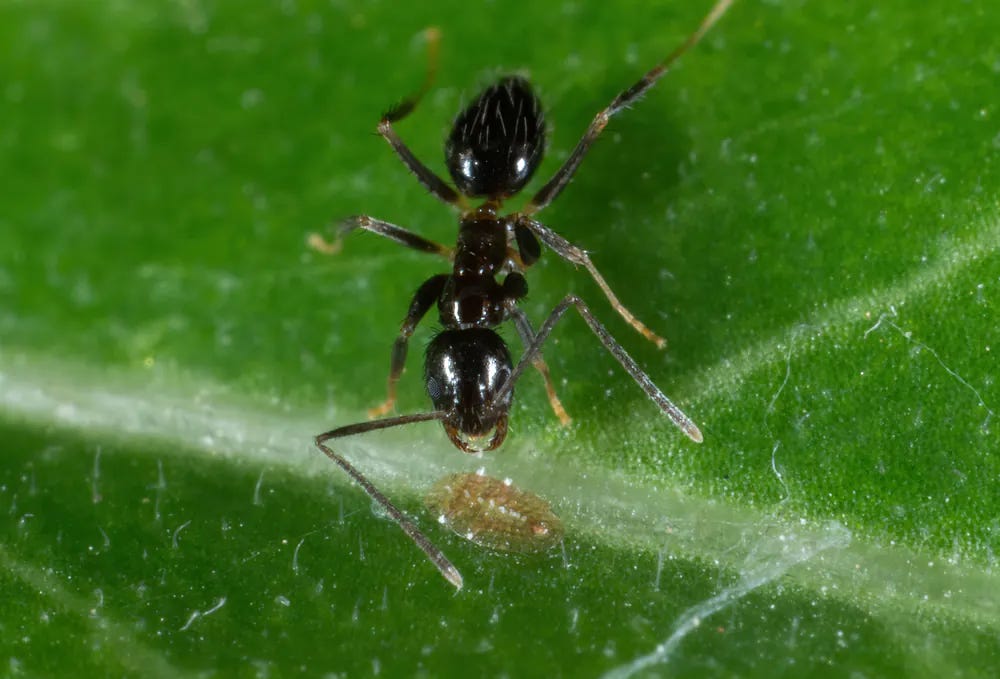
One of my honored teachers, John Wilkes—author of Flowforms: The Rhythmic Power of Water—was a designer and a nature scientist. I studied with him for a semester, and his insights have shaped the way I see the living world to this day.
I remember him saying about bees what could as well be said of ants: “The entity is not the insect—it is the hive. Everything and everyone exists for the good of others and for the life of the colony.”
That helped me to see that sympathy for the injured insect is misplaced. There is a greater wisdom in the hive or colony that the ant or bee serves.
What struck me then, and still does now, is how the life of the ant—or the bee—is never for itself alone. Each tiny creature is part of a greater whole, living in service to something beyond its own survival. That is a lesson worth pausing over.
No wonder Scripture directs our gaze to the ant. When we are tempted to self-absorption, Proverbs points us toward this smallest of teachers, who quietly models diligence, foresight, and cooperation.
The Ant as Teacher in Proverbs
Go to the ant, you sluggard!
Consider her ways and be wise,
Which, having no captain,
Overseer or ruler,
Provides her supplies in the summer,
And gathers her food in the harvest.Proverbs 6: 6-8
The Black Garden Ant
There are more than 13,000 known species of ants in the world—some that cut leaves, some that build nests high in trees, some that live as tiny guests in acorns. To do them all justice would take volumes. But for our purposes, I want to stay close to home.
The black garden ant (Lasius niger) is the one most of us already know. It runs across summer sidewalks, climbs through cracks in driveways, raids a picnic if we’re not careful. Precisely because it is ordinary, it is also the perfect doorway to wonder.
Look closely, and what seems common suddenly brims with surprises:
A queen can live nearly thirty years.
Colonies farm aphids like dairy cows.
Workers can carry loads fifty times their own weight.
Sick ants quietly remove themselves for the good of the whole.
There may be as many as 15,000 black garden ants in a single colony.
These ants help balance your garden’s ecosystem.
This is no nuisance insect! It is a teacher in miniature, showing us how strength and humility can dwell together in a community that endures.
The Ant’s Maiden Flight
On warm summer days, you may see a sudden flurry of “flying ants.” These are not a different species but alates—winged males and looking for virgin queens to take part in their nuptial flight.
Thousands rise together, mate on the wing, and scatter on the wind. The males live only a day or two, their purpose complete. The young queens drop to earth, tear off their wings, and vanish into the soil to found new kingdoms.
A queen quickly digs a tunnel, seals herself inside, and begins her patient vigil. For weeks she neither eats nor drinks, living off the reserves of her own body, even breaking down her flight muscles for nourishment. In the dark, she lays her first eggs. These hatch into pale larvae, helpless as maggots, which she must feed herself. When they spin their tiny cocoons and emerge as callow workers—white at first, then slowly darkening—the colony’s future begins.
The queen, now emaciated, has given away half her body weight, yet her first daughters immediately take up the work: foraging, feeding, tending the brood, and feeding their exhausted mother. From this moment, the queen’s only task is to lay eggs. Her workers expand the nest and bring food until the population grows into thousands. Some colonies endure for decades, with queens living up to 29 years—longer than any other insect known.
Work and Sacrifice in the Colony
Ants are miners, farmers, architects, and nurses, all in miniature They tend aphids like tiny cattle, stroking them to coax out droplets of honeydew. They protect their herds from predators, even driving away ladybirds. They also shelter butterfly larvae that repay them with sweet secretions, carrying them into the nest for safety until they mature.
Even sickness has its place in their order. Infected ants have been observed isolating themselves—venturing farther to forage, keeping away from the queen and brood—quietly sacrificing themselves for the good of the colony.
A Sovereign Commonwealth of Will
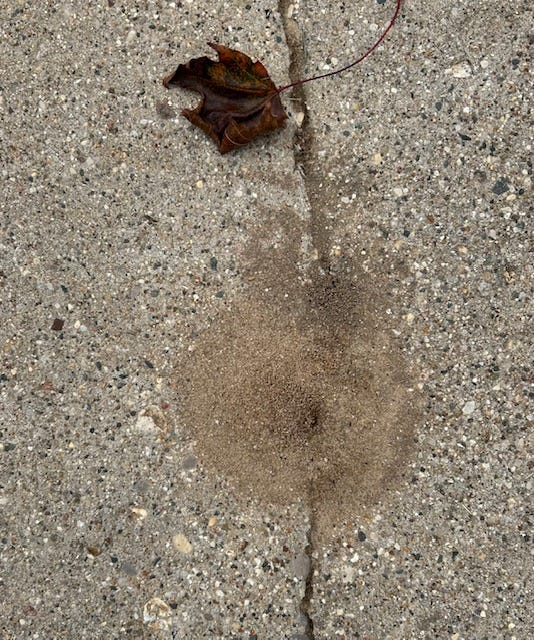
When we stoop low to look at an anthill it is like leaning over the gates of a city. The mound itself is only the skyline. Beneath, a labyrinth runs deeper and deeper: vaulted chambers for eggs and larvae, pantries for seeds and scraps, guard posts for soldiers, winding streets connecting it all. It is a city alive with movement, yet with no mayor or architect to direct it. Each ant follows an unseen order, and together they shape a world more complex than we imagine.
Ants do what we humans can hardly conceive: build ventilated cathedrals of soil, weave themselves into living bridges, farm tiny fungus gardens underground.
And we, if we bend low enough, may glimpse this teeming kingdom where strength and humility walk hand in hand.
Emily Dickinson once caught this vision in a few lines:
His mansion in the hill,
The ant’s republic in the dust,
The sovereign commonwealth of will.
Emily Dickinson saw what our eyes often miss: the anthill is a “sovereign commonwealth of will.” Her phrase tell us that even the smallest creatures carry an order far beyond themselves. An order written into Creation at the beginning of time.
Wisdom in Fable: The Ant and the Grasshopper
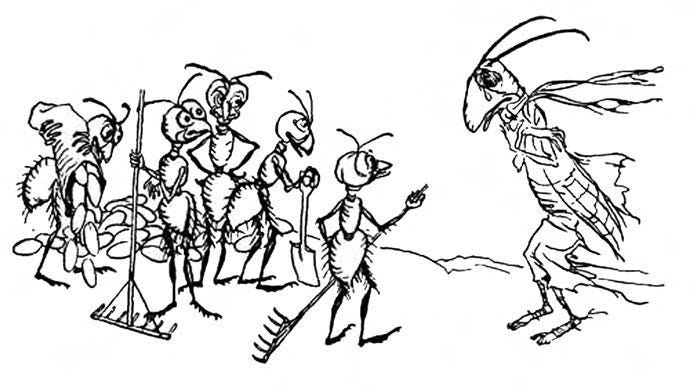
This wisdom echoes in the old stories as well. Aesop’s fables have carried such lessons for centuries, told in simple words that children never forget. Charlotte Mason herself recommended reading fables aloud in the early years, letting children narrate them back in their own words.
In our own Living Books Press edition of Aesop’s Fables (available here
One fine day in winter some ants were busy drying their store of corn, which had got rather damp during a long spell of rain. Presently up came a Grasshopper and begged them to spare her a few grains, “For,” she said, “I’m simply starving.”
The Ants stopped work for a moment, though this was against their principles. “May we ask,” said they, “what you were doing with yourself all last summer? Why didn’t you collect a store of food for the winter?”
“The fact is,” replied the Grasshopper, “I was so busy singing that I hadn’t the time.”
“If you spent the summer singing,” replied the Ants, “you can’t do better than spend the winter dancing.”
And they chuckled and went on with their work.
The tale may seem sharp, even unkind, but it holds the same reminder as Scripture: life carries seasons, and wisdom knows when to gather, when to prepare, and when to rest.
So whether in poetry, in Scripture, or in story, the lesson returns: the ant, humble and overlooked, carries a wisdom we need: LIfe has its seasons; readiness is everything; live for others; build with skill and beauty; work with the skills God gave you.
Watching Ants with Children
You don’t need special equipment to watch ants—only a patch of yard or sidewalk.
Together with your children, look for a small mound of soil with a hole in the center. This is the doorway to a hidden city. If you wait quietly, you’ll soon see ants hurrying in and out.
Option 1: Just Watch
Notice how the mound itself is made: tiny soil pellets carried up grain by grain from the tunnels below. Can you see ants carrying crumbs or seeds back down? Can you spot scouts wandering in different directions before returning with news?
Option 2: Leave a Treat
If you’d like to speed things along, sprinkle a few crumbs, seeds, or grains of sugar near the entrance. Be patient—first a scout will discover the food, then others will soon follow. Watch how quickly they form a trail, each ant carrying away its prize.
Encourage your children to crouch close, sketch the mound, or simply count how many ants they see in a minute. The more still you are, the more the busy world at your feet comes alive.
Want to see what’s happening beneath the surface? Insect Lore is a good sources for home kits for study. They have an anthill kit. Here is an article which includes simple diagrams of tunnels and chambers: Ant Hills, Nests, and Tunnel Systems (Insect Lore)
A Season for Work, for Gathering, for Rest
The black garden ant is small, common, and often seen as a nuisance. Yet its world is a world of discipline, sacrifice, and astonishing order. Scripture points us to her wisdom. Aesop gives us her story. Our own eyes confirm the truth: there is a time to work, a time to gather, and a time to rest.
If we are willing to stoop low and watch, the lesson is plain. Wisdom is not hidden in distant places—it walks in lines across our sidewalks, carrying crumbs home to a kingdom in the dust.
Enjoy the world outside your door today,
Sheila Carroll
Living Books Press