Every Shadow
The Dance of Light and Form, As Old as Creation Itself

September brings longer shadows as the sun sits lower in the sky. In summer the sun is high and the shadows lie close underfoot, but now they stretch across the ground. Autumn seems a season made for shadows. The mix of light and shade has a kind of quiet magic.
From my study window I look out on a walnut, a butternut, and an oak. The leaves still hang but are turning toward russet, gold, and brown. Their branches throw lace-like shadows on the lawn. A breeze moves, the light breaks apart, then joins again.
It set me wondering why shadow feels like something of its own, when it is only light interrupted.
The thought stayed with me, and a few mornings later I pondered it on a walk along the Chippewa River at Deerfield Park—a place I return to often, always the same and always ever new.
The morning was cool, the sun bright in the east. I stopped on a bench before a young red maple. At that moment the sun stood just behind the tree, and it cast a long dark shaft across the path. On either side the shade broke into finger-like tracery, stretching outward. I felt a sudden alertness, as though something was about to be revealed.
I captured the moment in the picture below—the maple rooted before me, the sun burning directly behind, and the shadow stretching straight towards my feet.
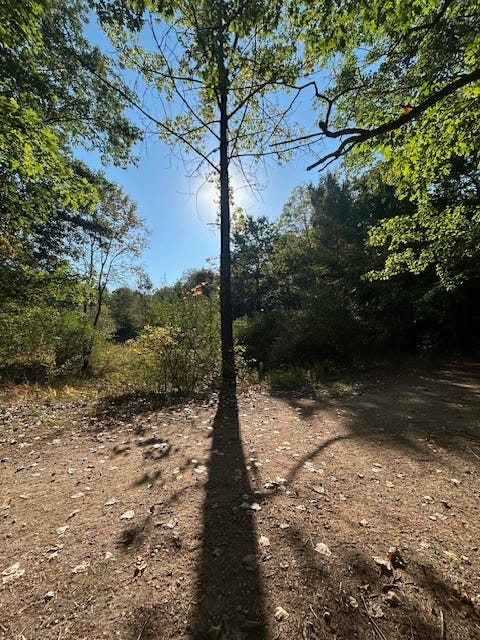
The Shadow’s Secret
What I saw was not simply an interruption of light, but presence—as if the shadow itself were substantial.
What did it mean?
Sitting before the young maple, I began to understand a little. Psalm 91 tells us:
He who dwells in the shelter of the Most High will abide in the shadow of the Almighty.
I have often wondered what that meant. In the desert, shadow is life-giving shade, a place of protection. But this was not desert.
The question rolled through my mind all week. It felt like a riddle. What was being shown to me?
Then I saw it. Shadows exist not only because of light, but because of matter—because there is form, substance, a world created. The shadow is its own contribution to the greater work of creation.
Where Scripture and Science Meet
Shadow did not exist at the first word—“Let there be light.” Only when God called forth form and substance could light be interrupted. Shadow was born with creation itself, the meeting of light and matter.
Science calls shadow the effect of light blocked by an object. Scripture calls it both the fleetingness of life and the shelter of the Almighty.
Taken together, shadow is no accident but a revelation: proof that creation is real, time is moving, and yet the light is always greater than what interrupts it.
Shadows Speak
Children sense this mystery. They chase their shadows, leap over them, try to trap them. Shadows feel like another self, a companion. Stevenson gave them a verse: “I have a little shadow that goes in and out with me.” Barrie gave them a story: Peter Pan losing his shadow, trying in vain to fasten it back on. The tale is playful, but it carries truth—shadows cannot be owned. They belong to the meeting of body and light.
Science, too, tells stories with shadow. Kepler said, “The very word ‘shadow’ is a reminder that light is present.” Eratosthenes measured the very size of the earth by watching the difference between two shadows on midsummer’s day.
And Scripture again: when King Hezekiah begged for healing, God gave him a sign—the shadow on the steps moved backward, time itself reversed. Shadows in the Bible are not tricks of light, but signs of life, mercy, and power.

Shadows Shape Life
Even in the smallest ways, shadows shape life. Moss clings to the shaded side of stones. Mushrooms rise in the shadows of the forest. Frogs hide beneath leaves. In the desert, creatures survive by “shadow-hopping” from one patch of shade to the next. A single rock’s shadow can be cool enough for a seed to sprout.
So I find myself watching differently now: the dappling of branches across the sidewalk, the softening of light at day’s end. Shadows are always more than they seem—timekeepers, shelters, reminders that light is near.
Try This With Your Children
Follow your shadow for a day. Where does it fall in the morning? At noon? In the evening? Is it long or short? What does it teach you about the sun’s journey?
Find a shaded spot and notice what grows there. What plants, insects, or animals make their home out of the direct light?
Make shadow art. Trace the outline of a leaf’s shadow or photograph the dappled light beneath a tree.
Your shadow may not say much—but it’s always speaking. About where you are, what you stand near, and where the light is coming from. Look for it. Let it follow. And don’t be afraid of the places where the light softens and the edges blur. That’s where mystery lives.
Inspiration for Nature Study
Has this reflection on shadows offered something new for your homeschool? I hope so. You’ll find more resources for nature walks, journals, and gentle science in our Nature Study Collection.
In the next Nature Study Notes, we’ll turn to the patron saint of the environment, whose feast day falls on October 4. I’ll be sharing some new thoughts on an old and beloved saint—St. Francis of Assisi.
Share Your Shadow Story
What have you noticed, or what have your children seen in their play? Have you traced your shadow, or watched it vanish at noon, or found shelter in shade on a hot day? Each story is another way the world speaks.
Put your answer in the comments below. Your sharing helps others.
With a grateful heart,
Sheila Carroll
Living Books Press