Keeping Bees
On Bees, Belonging, and the Older Conversation with the Land
Enjoy the Audio Version of This Reflection
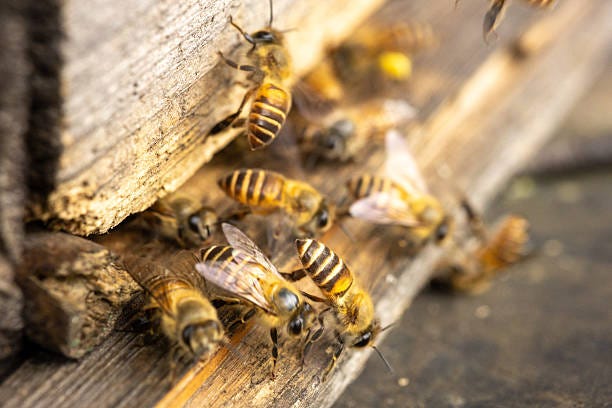
For more than forty years I kept bees, until the fifty-pound hive bodies became too heavy to lift.
Being a beekeeper meant entering into a conversation with these remarkably intelligent creatures. Learning the vibrations of their hum, the whirr of wings, and the different tones within the hive told you when they were content, distressed, preparing to swarm, or restless in winter when I would prop the cover slightly to allow them their quiet winter flight.
Keeping them healthy and thriving was both a joy and a challenge. The years my bees flourished, I felt we had done it together. The years they languished, I felt responsible. The bees taught me to listen, to observe carefully, and to learn their ways.
I first met the bees as a young woman while studying at Emerson College in East Sussex, England. John Wilkes, a teacher and creator of the Flowforms—sculptural vessels designed to aerate and enliven water through rhythmic movement—was also a beekeeper. One spring day he invited me to help with what he called “spring cleaning” in the bee yard.
I remember almost everything about that day.
It was early spring and, surprisingly for the English countryside, the sun shone. There was the smell of damp earth, weathered hives, beeswax, and smoke. The wooden hives stood in rows beneath the soft Sussex light while bees moved steadily in and out of the entrances with purposeful calm. I remember feeling slightly afraid and deeply drawn in at the same time.
John moved among the hives quietly and attentively, as though entering into conversation rather than managing livestock. I did not yet realize how much that mattered.
While I scraped propolis and old beeswax from the hive frames with a bee tool, John told the story of the nuptial flight of the virgin queen bee.
I have carried that story within me for more than fifty years.
“The hive knows when a new queen is needed,” he said. “A single female larva is chosen and fed royal jelly until she becomes the future matriarch of the colony.”
Then he described the flight itself.
“When the queen is ready, and the day is warm and filled with sunlight, she leaves the hive and rises upward into the summer air. She will mate only once in her lifetime. The drones follow her in widening spirals higher and higher into the light. Only the strongest will reach her.”
As he spoke, I could see it:
the queen ascending,
the drones circling upward beneath the open sky,
the great spiral of life unfolding above the fields.
“There,” he said quietly, “high in the warm air, the future of the hive is sealed.”
The queen returns carrying within her the future of the colony. The drones fall back toward the earth, their task completed. The queen enters the darkness of the hive again and remains there, laying as many as two thousand eggs a day for the rest of her life.
“What happened to the drones?” I asked.
“They die soon afterward,” he said gently.
I remember feeling saddened.
Then he looked directly at me and said something I have never forgotten:
“Don’t mourn for the bees that die, whether workers or drones. The real being is the hive itself, not the individual bee.”
I remember standing utterly still as he spoke, as if standing before a mystery.
Over time I began to understand that bees reveal something profound about the nature of creation itself. Nothing in the hive exists alone. Bees and blossoms, weather and water, soil and season, meadow and orchard all belong to one another. Human beings do too, whether we remember it or not.
The old beekeepers understood this instinctively. The flourishing of the hive depended upon the flourishing of the land itself. And human beings flourished best when they lived not as conquerors of creation, but as participants within a larger commonwealth of life.
Perhaps this is why the loss of bees feels so painful to so many people. Their disappearance touches something older than economics or agriculture. It awakens the fear that we ourselves have forgotten how to live in right relationship with the living world.
And perhaps that is what I have really been trying to recover in these essays all along:
an older vision of creation as alive with relationship, meaning, and presence.
The bees knew this long before we did.
These essays are part of a larger effort to recover an older vision of creation as alive with relationship, meaning, beauty, and presence.
If you would like to support this work and receive access to the Nature Study Archives, guides, and seasonal resources, you can become a paid subscriber below.
Sheila Carroll
Living Books Press