The Fields That We Know
What I Learned About Caring for the Natural World—One Yard, One Raccoon at a Time
Enjoy the Audio of this Week’s Reflection
This week, I spent time with two remarkable women.
Neither one appears on television or leads an international movement.
After getting to know them, I found myself thinking this may be how the world is made whole—not through grand gestures, but through faithful care of what is around us.
Let me explain.
Jim and I had traveled to Lake Michigan to visit some of our favorite places and walk the trails at Sleeping Bear Dune. During a stop at a coffee shop, I noticed a poster about a nonprofit that encourages the use of native plants in home landscapes. Curious, I followed the thread and eventually found myself visiting the organization’s director, Cheryl Gross, at her home near Traverse City.
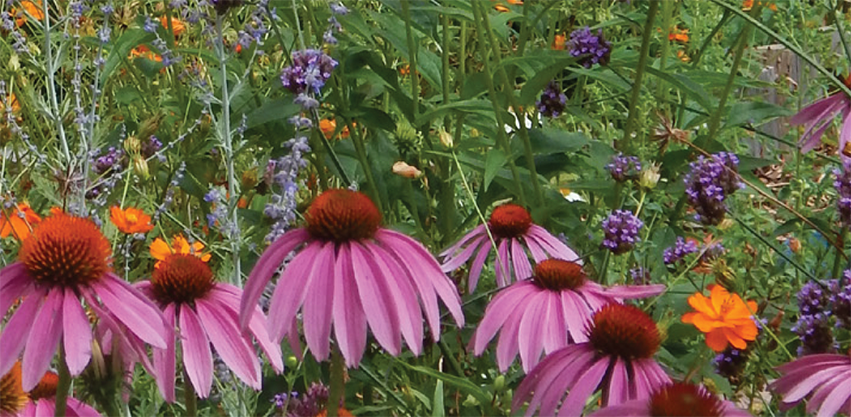
Cheryl’s yard, about a half acre front and back, is a wonder of native trees, flowers, grasses, shrubs, and ground cover—far too many to name. Over the past twelve years she has transformed the property into a sanctuary for native species, creating habitat for butterflies, birds and insects.
When I asked her why she did it, she spoke with real passion:
“We must do this—for the earth.”
Every garden bed testified to that conviction. Everywhere I looked were signs of patient care: flowers chosen for pollinators, shrubs planted for birds, native grasses restoring habitat, and countless small decisions made over many seasons. The yard had been shaped by years of observation, learning, mistakes, and perseverance.
Her yard seemed to embody a truth that is easily forgotten. The earth is rarely healed through dramatic acts. More often it is healed through thousands of small acts repeated faithfully over time.
As I drove home, I found myself thinking about Cheryl’s twelve years of labor. One plant at a time. One season at a time.
Then I thought about another woman whose work follows a similar pattern.
Readers may remember the little raccoon kit that appeared in our yard a few weeks ago and my struggle to find a way to care for it. That experience introduced me to a world most of us rarely see: wildlife rehabilitation.
Tina, director of MT Nest Farm, lives in that world every day. At this very moment she is feeding, warming, cleaning, and tending more than forty orphaned baby raccoons. Forty tiny creatures requiring formula, medicine, clean bedding, warmth, and endless patience.
Most of us will never witness the work that goes into keeping such vulnerable lives alive. We see the fox crossing a field at dusk or the raccoon slipping quietly back into the woods. We rarely see the midnight feedings, the careful monitoring, the hours of labor that made that moment possible.
Wildlife rehabilitators are among the unsung caretakers of the natural world. Their work is largely invisible, yet countless creatures owe their lives to such patient devotion.
Like Cheryl's garden, Tina's work is built from countless small acts repeated day after day. Neither is dramatic. Both require attention, patience, and care. Both are ways of tending a field entrusted to one's keeping.
Neither woman seemed burdened by the impossible task of fixing everything.
Instead, they were devoted to caring for what had been placed within their reach—and it gave them great pleasure to do so.
Watching Cheryl and Tina, I kept returning to a phrase that has stayed with me for years: the fields that we know.
Pope Leo recently quoted it in his encyclical Magnifica Humanitas (Magnificent Humanity), reminding us that the common good is not merely an ideal but a responsibility lived out in daily life.
The phrase comes from Tolkien’s The Return of the King:
It is not our part to master all the tides of the world, but to do what is in us for the succour of those years wherein we are set, uprooting the evil in the fields that we know, so that those who live after may have clean earth to till.
Not every field.
Not every problem.
Not the whole earth.
Only the field entrusted to us.
For Cheryl, that field is a yard of native plants. For Tina, it is a room full of orphaned raccoons.
Neither woman is saving the whole world. Yet both are making the world more whole.
There is deep wisdom in this, especially now when we are confronted daily with problems too large for any one person to solve. The scale of those problems often leaves us discouraged or numb. We begin to feel that nothing we do can possibly matter.
Tolkien shows us what’s possible: Tend the field you are given.
Everyone talks about saving the planet. Cheryl is planting sedge grass and native flowers.
Everyone worries about habitat loss. Tina is warming formula at midnight and releasing healthy animals onto a preserve.
Meanwhile, violets bloom quietly at our feet.
Small things often carry more life than we realize.
Perhaps one of the missing pieces of our time is that we increasingly think about the natural world through abstractions: ecosystems, sustainability, conservation, biodiversity. These are important words, but reality rarely presents itself in abstract terms.
Reality comes in the scent of warm earth after rain.
Reality is the astonishing agility of a baby raccoon’s paws wrapped around a bottle of formula.
Reality is violets blooming among clover and dandelions, each contributing in its own way to a commonwealth of life.
That is why nature study is so important.
Nature study helps us recover this reality. It trains us to see the world as it actually is rather than as an idea. We begin by noticing. Then, almost without realizing it, noticing becomes affection, and affection becomes care.
And from such attention something important begins to grow within us. Gratitude. Responsibility. Love.
The world is renewed not by extraordinary people doing extraordinary things, but by ordinary people loving ordinary places with extraordinary faithfulness.
A native garden planted.
A baby raccoon fed.
A patch of violets left to bloom.
And the field closest to us is almost always the one we are meant to tend.
Do you have a story about someone like Cheryl or Tina? Tell us about it below.
Sheila Carroll
Living Books Press