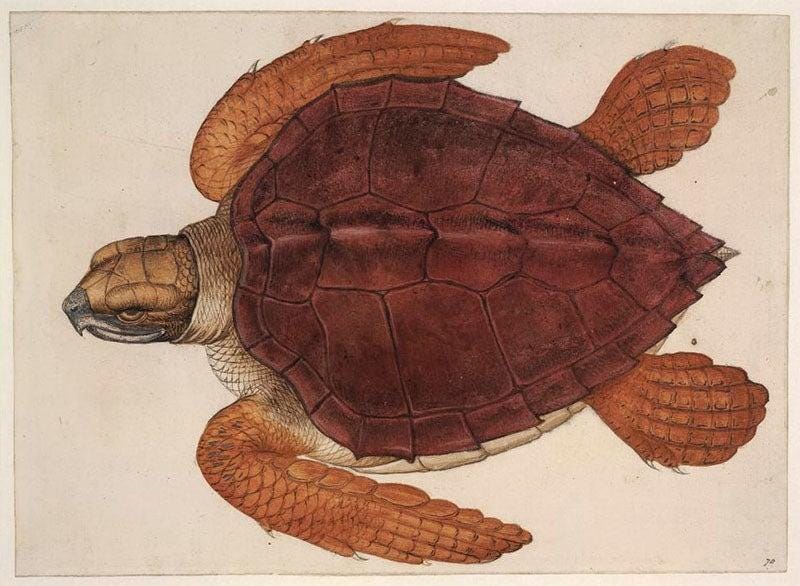
The Loggerhead Turtle
The Lost Colony of Roanoke and a Grandmother Learning to See
Enjoy the Audio
The other morning, I stood in my garden with my grandsons, trying to describe the blossom of a hosta plant to them. Nothing complicated—just the simple act of narrating what was right in front of us. The bloom was a cream color, slender and fluted, but that description still felt generic, as if I were naming a category rather than this particular flower. I wanted to show them how to describe what they see, and the irony was that I couldn’t describe this bloom any better than they could.
Later, I understood why.
I had been looking, not seeing.
The realization unsettled me. Because writ large, this is how we live now: surrounded by wonders we can name but cannot describe, familiar with everything and intimate with almost nothing. We skim. We scroll. We glance. We rarely kneel.
And in that small failure of attention—standing there with a hosta bloom I could not truly see—John White came to mind, along with the deeper question of what it means to see rightly.
In recent years I’ve been seeking out women and men of the past who possessed the vivid, reverent way of seeing the natural world that I’m trying to recover—John Ray, Louis Agassiz, Charlotte Mason. Along that path, I found John White of Roanoke.
White, governor of the Lost Colony, landed with the 1587 expedition that included his son‑in‑law, his daughter, and his infant granddaughter, Virginia Dare—the first English child born in the New World. Commissioned by Queen Elizabeth to document the journey, the artisan-naturalist White painted what he saw with a fidelity that still startles today. His luminous watercolors carry a quality of attention that feels almost impossible now—patient, reverent, exact.
I was deeply affected by those watercolors, made by one of the first English observers to encounter the New World. He is best known for his eloquent, detailed portrayals of the Algonquin people who had lived there for centuries.
But it is his paintings of plants and animals that interest me most. One painting in particular stays with me: his loggerhead turtle. If you expand the image above, the creature grows more itself the closer you look. And if you linger there—just for a moment—you can almost imagine the scene in which White first saw it.
Somewhere along the Carolina coast in the summer of 1585, he crouched near the edge of a tidal creek where the water runs warm and green. The air is thick with salt and pine resin. A loggerhead turtle hauled itself onto the sand, its great domed shell catching the late light like a burnished shield.
White waited and then simply knelt.
His sketchbook is open and ready. The paper is handmade, rough to the touch, easy to brush with watercolors from the small tins beside him. He wets the tip of his brush, touches it to the page, and begins.
The turtle is nearly three feet long and close to four hundred pounds, moving with the slow, deliberate heaviness of a creature shaped more by water than by land. White studies the angle of its neck, the way the skin folds like creased leather, the steady reach of its flippers. He notices the pattern of the scutes on the shell—each one slightly different, like the facets of a stone. He sees how the flippers press into the sand, leaving impressions that will be gone by morning.
He paints the turtle patiently, reflecting on its remarkable fitness for a life lived mostly in the sea, yet capable of coming ashore when it must. White is listening with his eyes.
There is no allegory here, no emblem, no moral lesson. The turtle isn’t “like” anything else; it is wholly itself. A creature offered itself to White’s attention, asking only to be seen.
Behind him, the surf breaks in its long, unending rhythm.
Before him, the turtle breathes.
And in that moment—this is the part I feel more than I really know—White is not thinking of England or the colony or the future. He is simply present. A man attending to a creature he has never seen before, trying to understand it with the only tools he has: patience, pigment, and the conviction that the world is worth noticing.
When he finishes, he sits back on his heels.
The turtle lumbers toward the water.
White watches until it disappears.
He closes his sketchbook.
He has captured something that will outlive him.
We live in a world as different from White’s as water is from sand—yet we are made of the same materials. The same creatures, the same light, the same rhythms of tide and season. There is a tangible kinship between us if we choose to see it.
White’s world was slower, but not simpler.
Our world is faster, but not richer.
What he had—and what I want—is a way of seeing that is not hurried, not possessive, not distracted.
Nature journaling is one way to become like White. A nature table that holds a child’s attention. Or, a book of nature poems, each poem full of sound and beauty.
Another way is simply to write your description in a notebook, as White’s companion Thomas Harriot did.
These are not artistic skills so much as human ones. They are qualities of attention and presence. They are ways of inhabiting the world.
White’s loggerhead turtle is not just a watercolor painting or a generic illustration. That turtle is the turtle that John White saw.
His painting was not just the fulfillment of a directive but an act of tender reverence.
I went back to the hosta.
…and looked again—longer this time, slower. I traced the curve of the petals with my eyes. I noticed the faint striping, the way the bloom flares at the tip like a tiny trumpet, and how the light pools inside the flower, a small, secret brightness. Only then did the inner architecture come into focus: the single pistil reaching forward like a pale thread, and around it the stamens, each tipped with an anther that—on these older blossoms—had darkened into tiny black flecks. They clung to the ends of the white filaments like minuscule seeds, the spent pollen sacs of a flower whose brief invitation to pollinators had already passed.
I realized then that the problem had never been the hosta. It was my attention.
Now the words came—not perfect, but true—I was seeing, truly seeing.
John White kneeling before a turtle;
A grandmother kneeling in her garden.
The posture is the same.
Both of us are trying to see the world as it is. I feel a kinship across the centuries—something in his way of seeing the world that meets my own longing to see more truly.
both of us learning to be patient, humble, curious, reverent,
Both of us are encountering something precious.
I would enjoy John White’s company—once again, there is something in his way of seeing the world that meets my own longing to see more truly.
Sheila Carroll
Living Books Press